
From a first SAT step to a 1500 and beyond: every course, clinic, and boot camp in MEK’s Spring 2027 SAT Prep, and how they fit together.
For nearly 30 years, MEK has helped students prepare for the tests that open college doors. The tests have changed many times in those years. Our belief has not. A strong score is built step by step, on skills a student truly owns.
Spring 2027 SAT Prep is organized as one clear path. Each course prepares a student for the next. Clinics strengthen the skills that hold a score back. A boot camp before every test date brings it all together. This post walks through each stage, including what is new this Spring, so you can see where your student fits today and where they are headed.
The path at a glance
Every student starts with the MEK SAT Evaluation. The results point to the right first course.
| Course | Who it’s for | Format | New this Spring |
| SAT Foundation | Below 1150 on the MEK SAT Evaluation | 21 lectures, 5 simulation tests; Friday or Saturday | Wednesday Math and English clinics, daily assignments, progress meetings |
| SAT 1400 | Below 1300 on the Evaluation, or Foundation graduates | 21 lectures, 20 weekly tests; Saturday | — |
| SAT 1500 | Working toward 1500+, placed by the Evaluation | 21 lectures, 20 weekly tests; Saturday | Science reading drills |
| SAT 1500 Advanced | 1450+ on an official SAT | 21 lectures, 20 tests; Friday | Science reading drills |
| SAT Math DQ Clinic | SAT 1400 and 1500 students | 21 lectures; Wednesday or Friday | Refined around recent Module 2 questions |
| SAT Vocabulary Clinic | SAT 1400 and 1500 students | 21 lectures; Wednesday or Friday | Refined inquiry-based method |
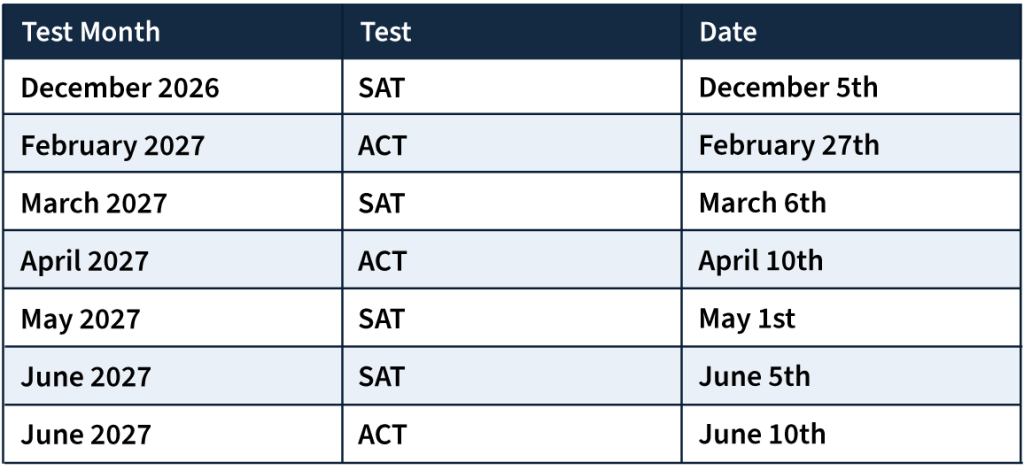
| Test Day Boot Camp | Any student with an upcoming test | 3 days before each SAT and ACT date | Now offered for every test date |
SAT Foundation, SAT 1400, and SAT 1500 begin January 9. All courses meet in a hybrid format, in person at our Closter campus or live online.
The typical path looks like this:
- SAT Foundation → build Module 1 confidence
- SAT 1400 → earn the harder Module 2 and perform consistently
- SAT 1500 → master the hardest Module 2
- SAT 1500 Advanced → perfect both modules after an official 1450+
Some students move from SAT Foundation to ACT 30 instead. Our counselors help each family decide.
Why a step-by-step path works on the digital SAT

The digital SAT is a multistage adaptive test. Each section, Reading and Writing and Math, has two modules. A student’s performance on Module 1 decides the difficulty of Module 2, and the difficulty of Module 2 decides how high the score can go. A student who struggles on Module 1 receives an easier Module 2, and the score is capped, even with every Module 2 question correct.
This is why we do not rush students to the hardest questions. A student who misses straightforward grammar, vocabulary, or algebra in Module 1 limits the score before the hard questions ever appear. Some students tell me the math felt easy, and then the score comes back in the mid-600s. Usually that means they lost points in Module 1 and received the easier Module 2.
Each MEK course matches a stage of this design. Foundation secures Module 1. SAT 1400 earns and handles the harder Module 2. SAT 1500 and 1500 Advanced master it. Students take simulation tests throughout, and our counselors use the results to recommend the right time to move up, so no student stays in a course longer than they need to.
SAT Foundation: master Module 1

SAT Foundation is our entry-level course for students who scored below 1150 on the MEK SAT Evaluation, or who are beginning SAT prep for the first time. These students rarely lack ability. More often, they carry habits that cost points, such as rushing, skipping steps, or second-guessing correct answers. Foundation replaces those habits with reliable methods.
In English, students build grammar mechanics, vocabulary and reading strategies, and evidence-based reasoning. In Math, they build algebraic concepts, a step-by-step approach to word problems, and accuracy habits that hold up under time pressure. Every lesson follows MEK’s philosophy: learn the right skills, erase the habits that hold a score back, and build confidence and stamina.
New this Spring
We have watched SAT Foundation closely for two years. Our honest observation is that the core sessions alone were not enough for some students to face a full-length test and step up to SAT 1400. So Foundation now does more:
- Wednesday Math and English clinics to practice strategy and drill core skills. In class, students begin learning Module 2 questions. In the clinic, they practice Module 1 until it becomes second nature.
- Daily routine assignments for short, consistent practice between classes
- Progress meetings after every 5 sessions
Schedule
SAT Foundation includes 21 lectures and five full-length simulation tests, one every three weeks, beginning January 9.
| Option | Math | English |
| Friday | 5:30 – 7:00 PM | 7:00 – 8:30 PM |
| Saturday | 9:00 – 10:30 AM | 10:30 AM – 12:00 PM |
| Wednesday clinics | [TIME] | [TIME] |
Sophomores benefit most from starting early. A student who completes Foundation in the spring of tenth grade enters junior year ready for higher-level test training. [LINK: SAT Foundation blog]
SAT 1400: break through the plateau

There is a point when the score stops climbing. The student knows the grammar rules and the algebra, and each practice test lands somewhere in the 1200s. At this stage, the problem is rarely knowledge. It is consistency: small errors under time pressure, lost focus late in a section, or a few hard questions the student has not been trained to approach.
SAT 1400 is designed for students who scored below 1300 on the MEK SAT Evaluation, including many Foundation graduates. The course shifts the focus from learning content to performing under real test conditions. Students take a full-length simulation test before every class, 20 tests alongside 21 lectures. Each class builds on what that week’s test revealed. By test day, the format, pacing, and pressure feel routine.
Schedule
SAT 1400 meets on Saturdays beginning January 9.
| Option | First class | Second class |
| Morning | Math, 9:00 – 10:30 AM | English, 10:30 AM – 12:00 PM |
| Midday | English, 12:30 – 2:00 PM | Math, 2:00 – 3:30 PM |
| Afternoon | Math, 3:30 – 5:00 PM | English, 5:00 – 6:30 PM |
SAT 1500: master the hardest Module 2

At the top of the score range, every question counts. A student in the 1400s already knows the content. The difference between a 1450 and a 1550 often comes down to a handful of questions: the hardest math problems at the end of a module, a word just unfamiliar enough to cause doubt, or a moment of hesitation on test day.
SAT 1500 is for students working toward 1500 or higher, placed by the MEK SAT Evaluation. Like SAT 1400, it is built on weekly full-length testing, with 20 simulation tests alongside 21 lectures. The work focuses on three things: eliminating every avoidable mistake, mastering the hardest question types, and performing consistently under pressure.
New this Spring: science reading
On the 2025–2026 tests, dense science passages caught many strong students off guard in Module 2. Students in SAT 1500 are already scoring around 700 or higher per section and are comfortable with easy and moderate Module 2 questions. Now they are ready for the polishing round. In class, they will work through science reading passages and learn a clear, repeatable strategy for solving them.
Schedule
SAT 1500 meets on Saturdays beginning January 9.
| Option | First class | Second class |
| Morning | Math, 9:00 – 10:30 AM | English, 10:30 AM – 12:00 PM |
| Midday | English, 12:30 – 2:00 PM | Math, 2:00 – 3:30 PM |
| Afternoon | Math, 3:30 – 5:00 PM | English, 5:00 – 6:30 PM |
SAT 1500 Advanced: perfect both modules

SAT 1500 Advanced is for students who have already earned 1450 or higher on an official SAT and want 1500 or above on their next test. These students do not need to learn the test. They need to perfect it.
The course takes a holistic approach to both modules. Students learn to think like a test-maker and predict how the SAT builds its hardest questions. They treat every question in Module 1 and Module 2 as a point that must be secured. Full-length simulation tests let them practice under real pressure, and they learn to remove the doubts that can cost a top scorer their best result. This Spring, 1500 Advanced also adds the new science reading drills.
Schedule
SAT 1500 Advanced includes 21 lectures and 20 tests. Classes meet on Fridays: English 5:30 – 7:00 PM, then Math 7:00 – 8:30 PM.
[LINK: SAT 1500 and 1500 Advanced blog]
The clinics: target the skill that holds a score back
For many students, the core course is enough. For others, one specific skill keeps holding the score back. Our two clinics, each with 21 lectures, are open to students in SAT 1400 or SAT 1500. Neither replaces the core course. Both work alongside it.
SAT Math DQ Clinic
On test day, there will be math questions a student has never learned. A strong Module 1 brings a harder Module 2, and the hardest version pours on multi-step reasoning, advanced functions, nonlinear equations, and challenging geometry. We call these difficult questions DQ. The DQ Clinic gives students repeated exposure to them, working through each one step by step: where to start, which method to use, and how to move through it without losing time or composure. Confidence comes from experience.
One caution: DQ practice alone is not a smart plan. A high score needs a strong Module 1 and a ready Module 2, which is why the clinic works alongside the core course.
SAT Vocabulary Clinic
SAT passages are short, usually under 200 words. Length is not the problem. Complexity is. The key to finding context quickly is vocabulary. Many families ask for a list of popular SAT words, but the test is skill-adaptive, and no one can predict its words. The reliable path is to master how words are built from roots, prefixes, and suffixes, and to use them as context clues.
A printed list also does not transfer to test day. The clinic takes a proactive approach instead:
- Bring the inquiry. Students bring the words that slowed them down in practice.
- Find the meaning. Together we uncover each word through its parts and its context.
- Expand the asset. Students apply the skill to new words, so their vocabulary keeps growing.
The thinking behind this clinic comes from our SAT English teacher, Iulia Boboc, in her post “5 Power Habits That Turn Mistakes Into Points.”
Which clinic fits
| If your student… | Consider |
| Loses points on the hardest Module 2 math questions | SAT Math DQ Clinic |
| Slows down on unfamiliar words, or Reading and Writing lags behind Math | SAT Vocabulary Clinic |
| Wants focused support in both sections | Both clinics |
Clinic schedule
| Clinic | Virtual | Hybrid (Closter) |
| SAT Math DQ Clinic | Wednesday, 5:30 – 7:00 PM | Friday, 7:00 – 8:30 PM |
| SAT Vocabulary Clinic | Wednesday, 7:00 – 8:30 PM | Friday, 5:30 – 7:00 PM |
The two clinics meet at different times, so students can take both.
Test Day Boot Camp: wrap up, filter, narrow
The days before a test are not for resting. They are for focusing. A test is an intense task, and students need time to engage before it. In three days, the boot camp helps each student wrap up their prep, narrow down what to focus on, and finalize their strategies. Students walk in with a healthy level of focus and a clear plan, so nothing on test day is a hassle or a surprise.
This Spring, every SAT and ACT administration has its own three-day boot camp:
Getting started
Every student begins with the MEK SAT Evaluation, a full-length SAT that shows exactly where they stand. Students aiming for SAT 1500 Advanced can share an official SAT score instead. Our counselors review the results and test history and recommend the right course, clinic, and boot camp. SAT Prep follows rolling enrollment, so students can join when they are ready and move up as their scores improve.
To learn what changed this Spring and why, read What’s New in MEK SAT & ACT Prep, Spring 2027. [LINK: replace with published blog URL]